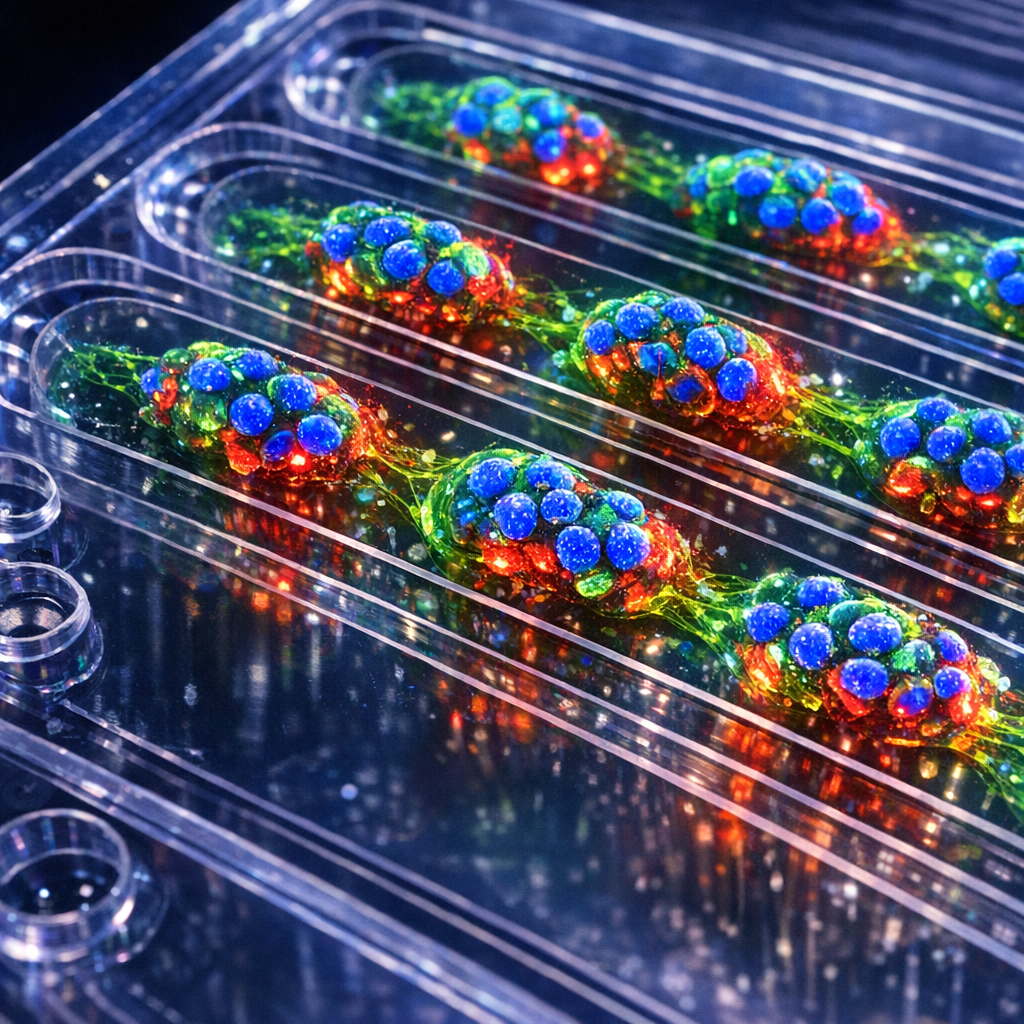
Discover how microfluidic high throughput 3D cell culture technology is revolutionizing drug discovery and tissue engineering by enabling researchers to create more physiologically relevant models at scale.
Understanding the Fundamentals of Microfluidic 3D Cell Culture
Microfluidic 3D cell culture represents a significant advancement in how researchers create and study cellular environments. Unlike conventional culture methods, microfluidic systems precisely control fluid flow at the microscale, enabling dynamic culture conditions that more closely mimic the native cellular microenvironment. These systems integrate miniaturized channels and chambers where cells grow in three-dimensional architectures, surrounded by extracellular matrix materials that support natural cell-cell and cell-matrix interactions.
The core principle behind microfluidic 3D culture involves manipulating small volumes of fluids—typically microliters to nanoliters—through channels with dimensions ranging from tens to hundreds of micrometers. This precise control allows researchers to maintain optimal nutrient gradients, oxygen levels, and waste removal in real-time, creating physiologically relevant conditions that support complex tissue formation. By combining microfluidic technology with 3D culture techniques, scientists can now study cellular behavior in environments that closely reflect in vivo conditions, leading to more predictive research outcomes.
Why High Throughput Capabilities Matter for Modern Research Workflows
Today's pharmaceutical and biotechnology research demands efficiency without compromising biological relevance. High throughput microfluidic 3D cell culture platforms address this critical need by enabling parallel processing of multiple experimental conditions simultaneously. This capability dramatically accelerates drug screening, toxicity testing, and biomarker discovery workflows, allowing research teams to evaluate hundreds or thousands of compounds in physiologically relevant 3D models within timeframes previously only achievable with traditional 2D assays.
The integration of automation and miniaturization in high throughput microfluidic systems offers substantial advantages for resource optimization. Researchers can significantly reduce reagent consumption, cell requirements, and overall experimental costs while maintaining reproducibility across multiple replicates. This efficiency is particularly valuable for pharmaceutical R&D labs working with limited primary cell samples or expensive compounds. By scaling experimentation while preserving biological complexity, high throughput 3D microfluidic platforms help research teams make more informed decisions earlier in the development pipeline, ultimately improving the probability of translational success.
Key Advantages Over Traditional Two-Dimensional Culture Methods
Traditional 2D cell culture on flat plastic surfaces has served as the workhorse of biological research for decades, but these simplified systems fail to recapitulate the complex three-dimensional architecture and microenvironmental cues present in living tissues. Cells cultured in 2D monolayers exhibit altered morphology, gene expression patterns, and drug responses compared to their in vivo counterparts. Microfluidic 3D cell culture overcomes these limitations by providing a scaffold for cells to organize spatially, establish proper polarity, and develop tissue-specific functions that are lost in conventional flat cultures.
Beyond improved biological relevance, microfluidic 3D systems offer precise spatiotemporal control over the cellular microenvironment that is simply not possible with static 2D cultures. Researchers can create and maintain biochemical gradients, apply mechanical stimuli, and dynamically adjust culture conditions to study cellular responses under controlled physiological or pathological scenarios. This level of control enables more accurate modeling of complex biological processes such as tumor invasion, immune cell migration, and tissue development. The enhanced predictivity of 3D microfluidic models translates to better correlation with clinical outcomes, reducing the costly disconnect between preclinical findings and human responses.
Applications Transforming Drug Discovery and Tissue Engineering
In drug discovery, microfluidic high throughput 3D cell culture is revolutionizing how pharmaceutical companies identify and validate therapeutic candidates. Organ-on-chip platforms—sophisticated microfluidic devices that recreate organ-level functionality—enable researchers to test drug efficacy and toxicity in human-relevant models before advancing to animal studies. These systems have proven particularly valuable for assessing cardiotoxicity, hepatotoxicity, and neurotoxicity, areas where traditional preclinical models often fail to predict human responses. By incorporating patient-derived cells or induced pluripotent stem cells, researchers can even create personalized disease models to explore precision medicine approaches.
Tissue engineering applications benefit tremendously from the precision and scalability of microfluidic 3D culture technologies. Researchers developing vascularized tissue constructs, complex organoids, and bioengineered implants rely on microfluidic systems to control the spatial organization of multiple cell types and guide tissue maturation through precisely controlled biochemical cues. The ability to perfuse developing tissues with nutrients while removing metabolic waste supports the creation of larger, more complex constructs that would not survive in static culture conditions. These advances are accelerating progress toward bioprinted organs, disease modeling platforms, and regenerative medicine therapies that could transform patient care.
Integrating Microfluidic Systems Into Your Laboratory Automation Strategy
Successfully incorporating microfluidic 3D cell culture into existing laboratory workflows requires thoughtful planning and integration with complementary technologies. Modern bioprinting platforms and automated liquid handling systems can work in concert with microfluidic devices to create comprehensive cell culture automation solutions. When evaluating systems for your laboratory, consider compatibility with your current imaging equipment, incubation infrastructure, and data management systems. Platforms that offer standardized interfaces and open software architectures provide greater flexibility for customization and future expansion as your research needs evolve.
Training and workflow optimization are essential components of successful technology adoption. Start by identifying specific research questions or bottlenecks in your current processes that microfluidic 3D culture could address most effectively. Pilot projects with well-defined objectives help your team develop expertise while demonstrating value to stakeholders. As proficiency grows, you can gradually expand applications and throughput. Look for technology partners who provide comprehensive support including protocol development assistance, training resources, and responsive technical service. This collaborative approach ensures your investment in microfluidic systems delivers meaningful improvements to your research workflow and contributes to more reproducible, physiologically relevant discoveries.